 ZISPofficial
NEBOSH IGC Syllabus 2026: GIC1, GIC2 and the Open-Book Exam Explained
22 October 2026 · 6 min read
By ZISP · Last updated: October 2026
The NEBOSH IGC syllabus 2026 uses new unit names: IG1 and IG2 are now GIC1 and GIC2. This guide explains what each unit covers, how the open-book exam works, and what actually changed, so you can plan your study with the right information.
Quick answer
The NEBOSH IGC syllabus 2026 is split into two units.. Unit 1 (formerly IG1, now GIC1) covers how to manage health and safety and is assessed by a 24-hour, scenario-based open-book exam taken online. Unit 2 (formerly IG2, now GIC2) is a practical risk assessment of a workplace. You must pass both units to earn the certificate.
What changed: IG1 and IG2 are now GIC1 and GIC2
NEBOSH reviewed its General Certificates and began teaching the revised syllabus on 2 February 2026. The first assessments under the revised syllabus took place from 4 March 2026, and the final assessments under the old (October 2018) specification were on 6 August 2026. Today, any new learner follows the NEBOSH IGC syllabus 2026, with units GIC1 and GIC2.
| Old specification (2018) | Revised specification (2026) | |
|---|---|---|
| Unit 1 | IG1 | GIC1 |
| Unit 2 | IG2 | GIC2 |
| Unit 1 assessment | 24-hour open-book exam | Still a 24-hour scenario-based assessment |
| Unit 2 marking | Met / not met | Points-based marking, with a mark breakdown issued to the learner |
| Unit 2 submission | Practical assessment | Submitted online through the NEBOSH Assessment Platform |
The qualification itself is the same one: it is still the NEBOSH International General Certificate in Occupational Health and Safety. NEBOSH also updated the definition of “incident” to match ISO 45001: an event at work that causes, or could cause, harm, injury, ill-health or damage.
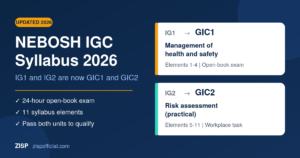
The NEBOSH IGC syllabus 2026 at a glance
| Unit | Formerly | Elements | Assessment |
|---|---|---|---|
| GIC1: Management of health and safety | IG1 | 1 to 4 | 24-hour online open-book, scenario-based exam |
| GIC2: Risk assessment | IG2 | 5 to 11 | Practical workplace risk assessment, submitted online |
GIC1 (formerly IG1): Management of health and safety
GIC1 is the “how do we manage safety?” unit. It covers four elements:
- Why we should manage workplace health and safety (moral, legal and financial reasons)
- How health and safety management systems work and what they look like
- Managing risk: understanding people and processes
- Health and safety monitoring and measuring
If you are a supervisor or manager, this is the unit that connects safety to your daily decisions: duties, policy, responsibilities, culture, behaviour, and how to measure whether controls are working.
GIC2 (formerly IG2): Risk assessment
GIC2 is the practical, hazard-focused unit. It covers seven elements:
- Physical and psychological health
- Musculoskeletal health
- Chemical and biological agents
- General workplace issues
- Work equipment
- Fire
- Electricity
Instead of answering exam questions, you carry out a risk assessment of a real workplace: spot hazards, judge and prioritise the risks, and propose an action plan. Under the revised specification it is marked with points rather than met/not met, and you receive a mark breakdown. Public sources report a 60% pass mark; confirm the current figure with NEBOSH or your learning partner.
How the open-book exam works
GIC1 is taken online, at a time arranged after your course. You have 24 hours to complete a scenario-based assessment, and you can refer to your course notes and materials while you write. Because it is online, you do not travel to an exam centre.
A few practical points:
- Your answers are marked by NEBOSH, not by your training provider.
- You need to pass both GIC1 and GIC2 to receive the certificate.
- Ask your provider for the exact exam window and submission steps before you book.
What “open book” does not mean
Open-book does not mean easy. The exam is scenario-based, so it tests whether you can apply the syllabus to a realistic situation, not whether you can copy a definition from your notes. A strong answer names the relevant concept, then links it directly to the facts in the scenario and explains what you would do and why.
How to prepare
- Learn the structure first. Know which element each topic belongs to, so you can find material fast under time pressure.
- Practise applying, not just recalling. Take a hazard or management failure and explain the cause, the consequence and the control.
- Build a short index of your notes. In an open-book exam, finding the right page quickly matters.
- Start your GIC2 workplace early. Choose a workplace you can access and walk it with the syllabus elements in mind.
- Plan your 24 hours. Decide in advance how long you will spend reading the scenario, drafting and proofreading.
ZISP trainer notes
The trap in open-book exams: answering the topic, not the scenario. With your notes in front of you, it is tempting to paste everything you know about a topic. Examiners want something different: an answer built from the facts in the scenario. If the scenario mentions a night shift, a new employee or a damaged guard, your answer should use those details.
A short worked example (element 9, work equipment). Imagine a scenario where a worker is injured on a machine whose guard was removed to speed up production.
- Name the concept: unsafe work equipment and inadequate guarding.
- Link it to the facts: the guard was removed to save time, which points to a production-pressure culture and weak supervision.
- Say what you would do: reinstall the guard, add interlocks, retrain the operator and add guard checks to inspections.
- Explain why: removing the hazard’s access point works better than relying on the worker to be careful.
Notice the pattern: concept, scenario facts, action, reason. It works for almost any scenario-based question.
How ZISP supports you. ZISP courses are built around real incident examples and case studies, so you practise applying the syllabus, not just reading it. You can study online, virtually or in the classroom, and you get 7-day learner support from internationally certified trainers.
FAQ
Are IG1 and IG2 still used?
The unit codes were replaced by GIC1 and GIC2 for teaching from 2 February 2026. The final assessments under the old specification were on 6 August 2026. People who studied under IG1 and IG2 hold the same International General Certificate.
Is the NEBOSH IGC exam really open book?
Yes. GIC1 is a 24-hour online open-book, scenario-based assessment. You may use your course materials, but you still have to apply them to the scenario.
Do I have to pass both units?
Yes. A pass in both GIC1 and GIC2 is required to achieve the certificate.
Is the NEBOSH IGC syllabus 2026 different from the old one?
NEBOSH’s review kept most of the existing content. The most visible changes are the unit names and how GIC2 is submitted and marked.
Who is the IGC for?
Managers, supervisors and staff who make day-to-day decisions that affect safety, and people starting a career in health and safety.
Next step
Ready to study the NEBOSH IGC syllabus 2026 with expert support? Explore ZISP courses, read our FAQ, or apply now. Need to check a ZISP certificate? Use our certificate verification page.
Questions about this topic? Contact our team →